Monday, 30 July 2012

A Walk on the Ridgeway

Nomi's youngest sister Maddy came to stay for the weekend. We spent a day doing typically Oxford things and took her to Catweazle where she played some of her extraordinary songs. She's only eighteen but already brimming with talent. Her music comes from exactly the right place.


And then we spent a day walking on the Ridgeway, the ancient prehistoric track that connects Goring to Avebury and which is riddled with ancient monuments along the way. We began at Kingston Lisle at the little known Blowing Stone, so called because you can play it like a trumpet. Kind of. This natural sarsen horn was supposed to have been used by King Alfred to rouse the English against the Vikings, but given that all we could muster was a soggy parp this doesn't seem very likely. Pity the neighbours.


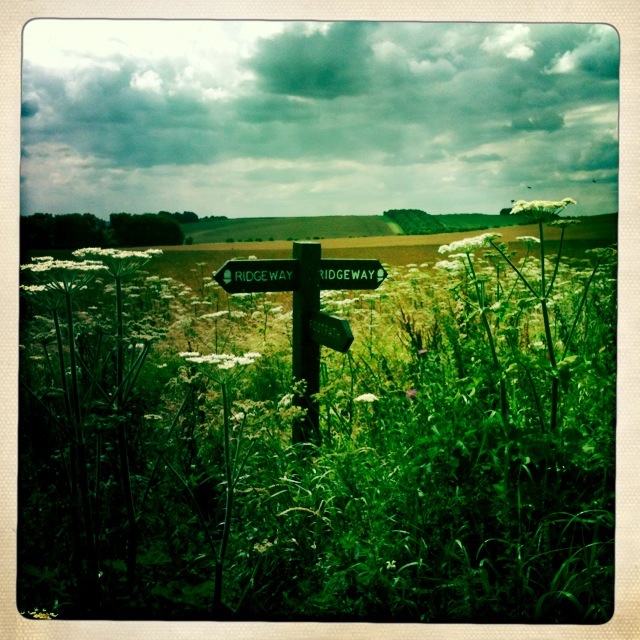
And then up to the Ridgeway itself, which runs like a chalk stream across the downs, urging the feet ever onwards.


There are often strange things on the Ridgeway, like this dead toad, squished flat and dried to a crisp. In spite of the walkers and the cyclists and the trail-bikes and the horse-riders, it remains that kind of place.


We walked to the prehistoric longbarrow known as Wayland's Smithy. Ancient by the time the Anglo-Saxons named it in honour of their smith god, legend says that if you tether your horse there overnight, with a groat for payment, Wayland himself will shoe it for you. I've not yet put this to the test, though I did spend part of my stag night trussed and blindfolded in one of the barrow's chambers (a story that probably deserves some explanation, though I'll save it for another time).


We didn't find Wayland but a man trying to get the perfect photograph, a task made considerably harder by the fact that this was a busy summer Saturday. Families and walkers kept coming into view. It's interesting why we always want to capture our ancient monuments unpeopled - in reality they rarely are.


There's usually some graffiti on the stones and trees. No, I don't know what the images mean either, other than that people feel the need to let others know they were there (as I'm doing here). Chalk marks don't seem to leave any permanent damage so it's a curiosity not a problem. I rather like it.


Wayland's Smithy has a reputation for being an edgy sort of place, somewhere where you're likely to find bikers getting pissed on cider or people fumbling in the bushes or other nefarious goings on. I've never found it so. The spirit of the place is restful. There's always that hoped-for feeling of otherworldliness. The hairs on the back of the neck tingle obligingly. We ate sandwiches and lingered, waiting for the sun to come out again.


Then, back onto the Ridgeway, homewards. Uffington Castle looked glorious against the summer sky. It used to be thought that this and similar Iron Age earthworks were hillforts, defensive structures in an age of turmoil and war. The latest idea is that they were more like festival sites, the banks and ditches purely for show (why else would they be so poorly defended round the back?). I like this idea and am running with it.


By late afternoon the sun was hot but a cool wind was blowing in from the West. You could just catch the tang of salt, the smell of the sea. We found a shady spot and lingered again, unwilling to come off the downs and to drop back into the twenty-first century. In a summer of downpours and uncertain weather it proved the perfect summer's day. We squeezed out every last drop.


Thursday, 19 July 2012

First Catch Your Hare

One morning at Chateau d'Ars, I awoke to find something strange hanging from the hedge. From a distance it looked like a cat.


On closer inspection it turned out to be a wood-cat, a stubble-stag, a shook-deer, a wry-leg, a cow-with-leather-horns, a malkin, a long-ear, a cross-mouth, a hare.


It looked rather sinister and I immediately suspected foul-play. Had someone been out hunting? Was it a sacrifice? A warning from the local farmer not to stray into his fields? 

In fact it was a bit of road-kill, retrieved by a Dutch family on their way back from the village of Saint Chartier (where, it seems, the party had been in full swing). It just so happens that they regularly eat road-kill (herbivores only) and so they were delighted when they'd spotted this hare. It was still warm which meant it was fresh and probably good to eat.

They went to La Chatre to buy a decent knife, then set about preparing the meat. First they hung it up, cut an artery, and left it so that the blood could drain. Then they removed the head...


...next the skin...


...then the intestines (carefully, so not to split them)...


...and finally the organs. It was like a biology lesson (or, as Jo my travelling companion and fellow piper put it, a Christmas stocking) and I found it fascinating, not remotely ghoulish. This is the side of food-preparation we never see. It felt important to watch.

"What are those strange white things?" I asked.
"It seems he was a boy."
"Ah!"
My biology is a bit rusty.


They butchered the meat and cooked it in wine. Something that otherwise would have gone to waste fed seven people. That's what I call an ethical meal.


I tasted it and it was delicious, dark, rich and gamey. It stirred something in me.

And that night I dreamt of a hollow for a home and that the moonlight jagging across the furrowed fields was a kind of road, urging me to run.

And so I ran.

More on St Chartier

To misappropriate Mark Twain, rumours of the death of St Chartier have been greatly exaggerated...

Tuesday, 17 July 2012

Saint Chartier est Mort, Vive Château d'Ars!

In the summer of 1996, when I footloose and fancy free, I cycled to central France. I was headed for the Rencontres des Luthiers et Maitres Sonneurs, the annual festival of instrument makers and master pipers at St Chartier. It took me three weeks to get there, but mainly because I was busking through Brittany as I went.


I look back at the journey fondly though it was tough at the time. I was unfit and had way too much stuff. I obsessed about timings and distances and my ever-dwindling supply of money. I never quite got the hang of busking in France - to be fair my piping wasn't up to much back then - and by the time I got back to Roscoff I had a pound in my pocket, though that's another story.

But cycling made getting there so rewarding. As I approached the village I heard the sound of a rauschpfeife playing a medieval Spanish cantiga. I promptly welled up. Saint Chartier had that effect.

Despite my woeful french I fell in with a group of like-minded medieval-enthusiasts from Nancy. We had a fine time playing bagpipes together and singing lays and ballads under the stars. And yes, I had a rather beautiful holiday romance too.


I went back to St Chartier many times and each holds wonderful memories.


The festival was unique. It drew musicians from all over Europe who came to buy instruments, to listen and to play. There were unforgettable jams and all night dancing, to bagpipes and hurdy-gurdies of course, on streets baked hot by the sun. It was troubadour heaven.


At night things turned more carnivalesque, like a Bruegel painting or better a Bosch. There was a wildness, a kind of crackling magic in the air that left me spinning and uncertain of what century it was - the twelfth? the eighteenth? Time rippled. 


Imagine my sadness, then, when in 2008 I learned that the chateau was to be sold and that the new owner wanted nothing to do with the festival (he's turned it into a Catholic retreat centre of all things). It was all over. 

Not quite. The organisers persevered and found a new venue five miles down the road at another chateau, the Chateau d'Ars. They set about transplanting the whole thing. It's taken me four years to summon up the courage to go again. How could it ever be the same?


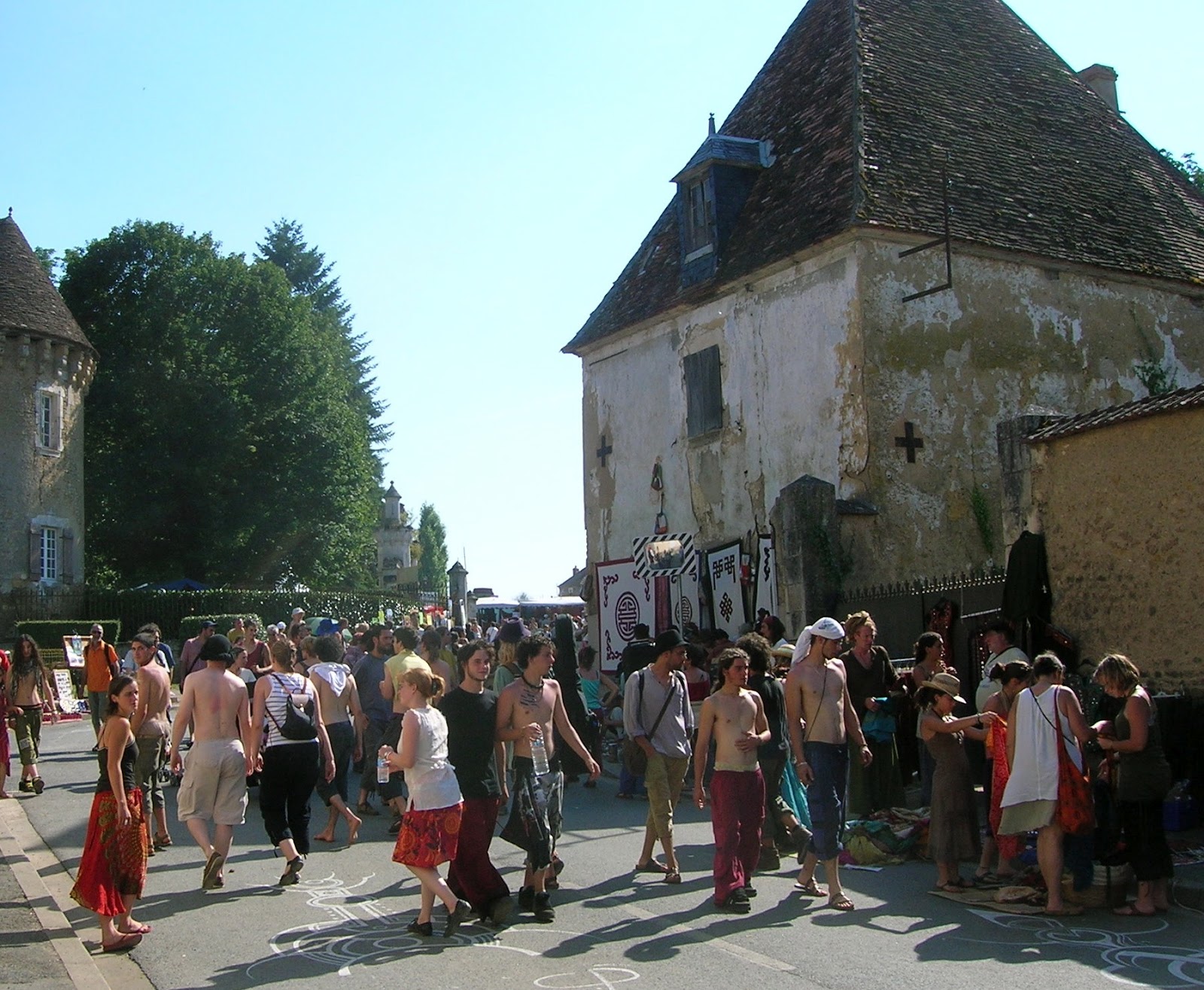
Well, of course it couldn't. It's something new built on old foundations. Undoubtedly it's tamer. Much of the wildness is gone. For one thing it all takes place in the chateau grounds and you have to pay to go in - at night it's dead outside and the campsite is quiet. There's no village scene, no bars heaving with musicians, no seething crowds on the streets.


I got very sad on the first night and took myself off for a walk. I needed to let Saint Chartier go. But once I'd done so I started to enjoy the new festival for what it is.

At its heart it's the same, a place for instrument-makers to exhibit their wares. Without them there would be no music, no tradition, no festival. 130 of them came this year . Their work is exquisite. The sound of all those instruments being tried at once is something you have to hear!


Here's an organistrum, the earliest type of hurdy-gurdy, reconstructed from Spanish medieval church carvings.


And here's the latest hurdy-gurdy, a steampunk creation that could be straight from from one of Jean-Pierre Jeunet's films.


These German bagpipes were positively teutonic...


...while this struck me as the lamest instrument I'd ever seen, a three-holed pipe with a fiddle on it (or vice versa). I'm not sure the 'whiddle' will catch on.


Everywhere you looked you found the beautiful, the unexpected and the kitsch.


There were many familiar faces from the old Saint Chartier days.


(Old soul Luc Arbogast showed up but I was so transfixed by his singing that I failed to get a photo. If you've never seen him, here's why I was so transported...)


Some of the old French hippy vibe has survived the transplant. A beautifully chilled tea-tent served chai and mate twenty-four seven; a traveller's crepe stall did a roaring trade; while the honey stall served delicious, locally-made hydromel or mead. And this being France you could get your snails hot.


All the toilets were compost loos. To drink you had to buy your own eco-cup that you used for the duration. Consequently there was no broken glass anywhere and barely any litter. The French seem to have a very different attitude towards intoxication: there was no binge drinking, and the occasional sweet drifting smell of hashish seemed to be tolerated or simply ignored.

The weather wasn't too unkind though even in central France the roaming jet stream that has blighted our summer brought rain. The mud, however, was slight and bearable and people just carried on dancing in wellies and kagouls.


Sessions went on regardless.


There was a pretty-much permanent Irish session in one of the food areas. At one point it looked like they'd played all the tunes but an emergency supply was brought in from Limerick, and off they went again...

The sun did eventually come out and all was well with the world.


I saw some great bands. Watch out for Clica Drona, winners of the band competition (they appear at 5.50).


An evening of experimental bands mixing trad instruments with beats and samples was met with unbridled enthusiasm not the pursed-lipped tutting of folk police. Of these, my favourite was Breton group, Krennijenn. They so had the funk.


Imagine the scene. It's late, the dance floor is packed. We're dancing in concentric circles bound within a greater circle of trees. Young and old dance together. The vibe is sexy and cool. We grin at each other as we pass - the music is just too good! - and as it peaks in intensity a great wave of euphoria passes over us. People whoop and shout. This isn't rave. It's folk music, the original trance.

I look to the sky and see stars and I'm suddenly filled with that bittersweet joy that brought me back to Saint Chartier time and time again.

The feeling is there alright. Saint Chartier is dead, long live Chateau d'Ars! See you there next year.