Tuesday, 29 April 2014

Up the May!

When deciding to leave Oxford, one of the hardest things to let go was May Morning. I fell in love with it from the start and have been going out and doing stuff ever since.


Ten years ago I got the Whirly Band together, and over that period it grew from this:


via this:


to this:


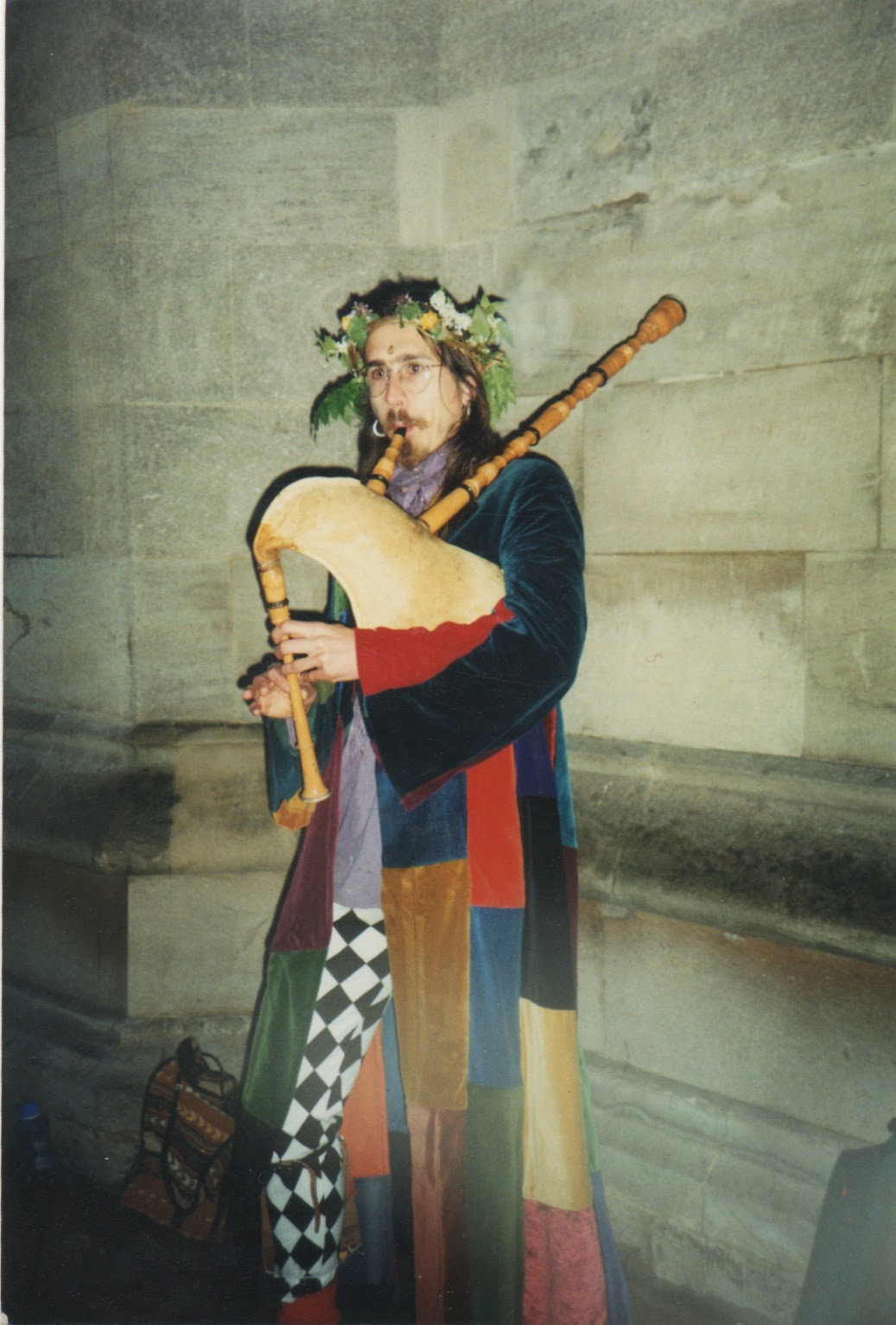
Along the way I discovered the Bosky Man (or perhaps it's more accurate to say he discovered me).


Various people have been asking if I'll be coming back this year to take my traditional place at 6 o'clock in the morning on the Clarendon steps. They already know the answer. Leave or don't leave. There is no middle ground. In any case, having gone it would feel dishonest to claim to represent a community I'm no longer an immediate part of, nor to channel the spirit of a land I no longer tread. Dartmoor has gotten into my veins again. My blood runs a different colour. No, this year I shall be having a year off, fulfilling a long-cherished desire to go to Cornwall to see the Padstow 'Obby 'Oss. I'll let you know how that goes.

But I've left the Whirly Band in the very capable hands of friend and expert piper, Jo Hamilton, to whom I've passed the bosky baton in a secret midnight ritual. Just as the band changed and grew during the decade I was at the helm, so, I'm sure, it will become something else again under her leadership. That's just what traditions do.


But to all my Oxford friends: I miss you and I shall be thinking of you and if I'm up in time, I shall raise a glass to you. May your day be blessed.

Up the May!

Telling the Bees free download!

Work on the new Telling the Bees album is progressing nicely with eight tracks recorded. There's still a long way to go, however, so we're looking at a release date in early 2015.

However, mindful of the fact that's a long time to wait, we're making our new single available for free download, but for one day only.

That's right. The Oxford May Song will be available for free download for just one day on May 1st 2014. Grab it from our website.

And if that's simply too long to wait, here's a video of us playing an acoustic Waiting for the Dawn at Folk Weekend Oxford. What busy bees we are!

Monday, 21 April 2014

On the kithara

I am often in awe of the craftsmanship and ingenuity of instrument-makers (luthiers), so here's a link to a video explaining the workings of the Ancient Greek Kithara, the instrument beloved of the god Apollo. Whoever invented the 'whammy bar', the device which gives this ancient lyre its characteristic vibrato, must have been divinely inspired, as must have Michalis Georgiou, the luthier who patiently rediscovered it.


Monday, 14 April 2014

On Twitter, birds and bards

Somewhat late in the game, I (@AndyLetcher) and Telling the Bees (@TellingBees) have joined Twitter. You are cordially invited to follow us.

Why so long? Aside from an innate mistrust of new technology that borders on luddism (I play the bagpipes after all, a piece of technology honed in antiquity) I wasn't sure I wanted to enter a world that prides itself on its inconsequentiality. The developers of the site seized playfully upon the old meaning of twitter - 'to talk in a quick and informal way about unimportant things' - and so set up a domain that, from the off, was all about knowing irony, the permanent arch of the eyebrow.

I have been persuaded, however, that while this may indeed be the case for the celebrity feeds and other candy floss you find there, Twitter is actually an invaluable tool for the hardworking folk musician. Indeed, some say that tweeting is actually something of a modern day bardic artform, not unlike the blog form which I have clearly embraced wholeheartedly.

Coincidentally, at the same time as I've joined the twittersphere, I've been spending a lot of time listening to and recording birdsong, the study of which rather belies the origins of 'twitter' as a derogatory term.

Take a listen to this blackbird, singing merrily at dawn, just the other day, from a magnolia tree in the next door garden.


Now take a listen to the same song slowed down by 60% and dropped in pitch by an octave. It sounds more like something the BBC Radiophonic Workshop might have produced in the 1980s than a garden bird.


Nothing inconsequential here. Indeed, I think the members of the thrush family could easily serve as totems for the modern day bard for each has much to teach us.

From the wren we learn the importance of technique, for how else could a bird so small produce a song that loud and clear if not through technique? If only my singing were so effortless.


Next, the song thrush. At his prime, a male improvises through something in the region of 140-220 different song types, learned through his lifetime, and so he teaches us the importance of repertoire and of the power of improvisation within a form.


But for sheer enchantment, for the ability to hold the listener transfixed or to send them into some dreamy torpor, it has to be the blackbird every time, which is why I chose him for our record label, Black Thrustle.


Of course, the nightingale possesses all three qualities and so represents the mastery to which all bards aspire and for which a lifetime's dedication is required. Sadly, you'd be hard-pressed to hear one these days.

There is one final member of the thrush family I should mention, the Mistle Thrush. With his speckled breast he's the most beautiful of them all and I've spent happy hours watching him strut his stuff in the undergrowth. But his song remains dismal, one of the few I actively can't bear. Hours upon end of dribbling tunelessness.

The Mistle Thrush reminds us not to be beguiled by outward display but to see through to what, if anything, lies beneath.

For in all spheres of life, not all that twitters is gold.
Wednesday, 9 April 2014

We want the funk

Traditionally, and in spite of several funk incursions, Western pop and rock has been wedded to the backbeat. This means in a 4/4 rhythm emphasising the two and the four: one-TWO-three-FOUR. Think: we-WILL-we-WILL rock you.

Just as we're all drawn to different styles of music, different timbres and different scales, so are we drawn to different rhythms - they each have their own personalities. The backbeat can be spectacular, as on John Bonham's behemoth opening to Led Zeppelin's 'When the levee breaks',  but I've never particularly liked it.


In fact, I find it ruins many a beautiful song. What was the producer thinking here?


The foursquare backbeat is about solidity and gravity. You can't dance to it because it keeps your feet anchored firmly to the floor. The best you can do is contort your body in ever more excruciating shapes. Along with Thatcherism and cocaine, I hold the backbeat responsible for the 1980s.


Happily, at the end of the decade an unstoppable tide of electronic dance music swept the backbeat away. Producers realised that if you wanted people to dance, you needed funk.

Funk can be explained quite simply as a matter of syncopation, groove and the semi-mystical concept of the one...


But funk can't be analysed. It doesn't come from the head, or even the heart, but rises up from the fleecy shanks of the loins. I know more than one drummer who, though they get all their beats down with mathematical precision, just don't have it. You've either got the funk or you haven't.

It's more an attitude to life than anything. In fact, I'd go further. For when the physicists finally drill down into matter so deeply they can go no further, they'll discover that the fundamental particle is pure undiluted funk. Funk is life itself.

And though funk, in its current manifestation, is an Afro-American creation, it's truly universal. I've heard it everywhere, from Indian tabla playing to Irish fiddling. It's just that in white Western culture, where the fact that we have bodies comes as a something of a revelation, we must fight continually against the gravitational pull of the backbeat. Funk is our Holy Grail.


When you hear the song the Mighty Boosh were parodying, you realise that the quest for the funk has only just begun.